What the Morris Delta measures
Your handicap says what level you are. The Morris Delta says how you play for that level. Two 12-handicappers get to their number in different ways: one gains strokes on the par 5s and gives them back on the par 3s, the other the opposite. The Fairway Report shows you which one you are.
It reads like a golf score: negative is better. Each tenth is a tenth of a stroke per 18-hole round, measured against what federated golfers of your handicap average on the same kinds of hole.
- −1.0One stroke per round better than your level.
- 0.0Level with your handicap: the report says so between −0.05 and +0.05.
- +1.0One stroke per round worse than your level.
From scorecard to number in five steps
Every hole of every card goes through the same five steps. Alongside runs hole 1 of the worked example below, so you can see what happens to a real number on the way.
Your official cards
The individual rounds the RFEG keeps with a hole-by-hole score. Team formats (fourball, foursome, greensome, scramble) stay out: those cards belong to two players.
9 on a par 4
Net double bogey cap
No hole counts for more than par + 2 + the strokes you receive on it, the same rule the handicap uses (Rule 3.1b). A disaster hurts, but it cannot swallow the round.
Counts 7: +3
Course difficulty out
What that course, from those tees, adds to your level comes off: (Course Rating − par) + Handicap Index × (Slope Rating − 113) / 113, spread over 18 holes (Rule 6.1a).
+3 − 0.11 = +2.89
Your level on that kind of hole
The average of federated golfers of your handicap on holes of the same par and the same third of difficulty, with their course taken out the same way.
Their level: +1.35
Average per hole, times 18
The difference on each hole, averaged over all your rounds in the window and multiplied by 18, is your Morris Delta in strokes per round.
Hole 1: +1.54
A worked example you can redo: three holes
Every figure in this example is invented. The player is Álex, the fictional golfer of the sample report, with a Handicap Index of 11.8 and a playing handicap of 13 on the card, so Álex receives a stroke on stroke-index holes 1 to 13. The course is fictional too: par 72, Course Rating 72.1 and Slope Rating 131.
What the course adds to their level
(72.1 − 72) + 11.8 × (131 − 113) / 113 = 0.10 + 1.88 = 1.98 strokes per round
1.98 / 18 = 0.11 a hole
These are the strokes a Course Handicap of 13.78 (before rounding) gives above a Handicap Index of 11.8. Spread over 18 holes, 0.11 a hole.
| Hole | Par | Stroke index | Strokes | Cap | Over par | Course out | Their level* | Difference |
|---|---|---|---|---|---|---|---|---|
| 1 | 4 | 3 | 9 | 7 | +3 | +2.89 | +1.35 | +1.54 |
| 2 | 3 | 16 | 3 | 5 | 0 | −0.11 | +0.55 | −0.66 |
| 3 | 5 | 9 | 5 | 8 | 0 | −0.11 | +0.85 | −0.96 |
| Total of the three holes | −0.08 | |||||||
*Illustrative average of federated golfers of that handicap on that kind of hole. In the report it comes from the real base, rebuilt every day.
Swipe to see the whole table.
Hole 1 costs Álex +1.54 strokes against their level, even though the cap forgives two: 9 taken, 7 counted. Holes 2 and 3 give back −0.66 and −0.96. Over three holes, −0.08: −0.027 a hole, which over 18 holes is −0.48 strokes per round.
The report does the same sum over the 738 holes of the last 41 rounds and gets −0.83: the −0.8 in the capture.
Who you are compared with: golfers of your handicap, on the same kind of hole
The benchmark is federated golfers whose Handicap Index was close to yours on the day they played, not tour players and not an overall average. For each kind of hole, Morris takes the holes played by golfers within ±2 strokes of your index: at 11.8, from 9.8 to 13.8. If that band holds fewer than 250 holes of that kind, it widens step by step until it does.
A kind of hole pairs the par with the difficulty the card gives it: the six holes with stroke index 1 to 6, the six with 7 to 12 and the six with 13 to 18. Three pars make nine kinds, and a hard par 4 is only ever compared with hard par 4s.
Two more rules keep the comparison honest. Your own rounds come out of the benchmark, so you are never compared with yourself. And each round is compared with rounds of its own handicap era: those under the EGA system with EGA rounds, those under the World Handicap System with WHS rounds.
Those golfers are RFEG licence holders whose cards Morris reads because they have connected their federation account. The benchmark is rebuilt every day as new rounds come in.
Which rounds count, and how many you need
- Which rounds
- Individual rounds with a hole-by-hole card and the playing handicap on it.
- Which cards
- At least 9 holes with a par, 60% of them with a score, on courses of par 62 or more per 18 holes: pitch & putt stays out.
- Which window
- Your rounds of the last three years; if there are fewer than 40, your last 40.
- How many
- 10 readable rounds, about 180 holes. Each par needs 12 holes to get its own figure.
- When
- It updates by itself, minutes after each new RFEG round comes in.
How to read your report
The report opens with your Delta and places you among the golfers of the base. Then it splits it into parts that add up to the same thing: by par, by hole length, by stretch of the round, by course, by season and by weather. Always in strokes per round against your level.
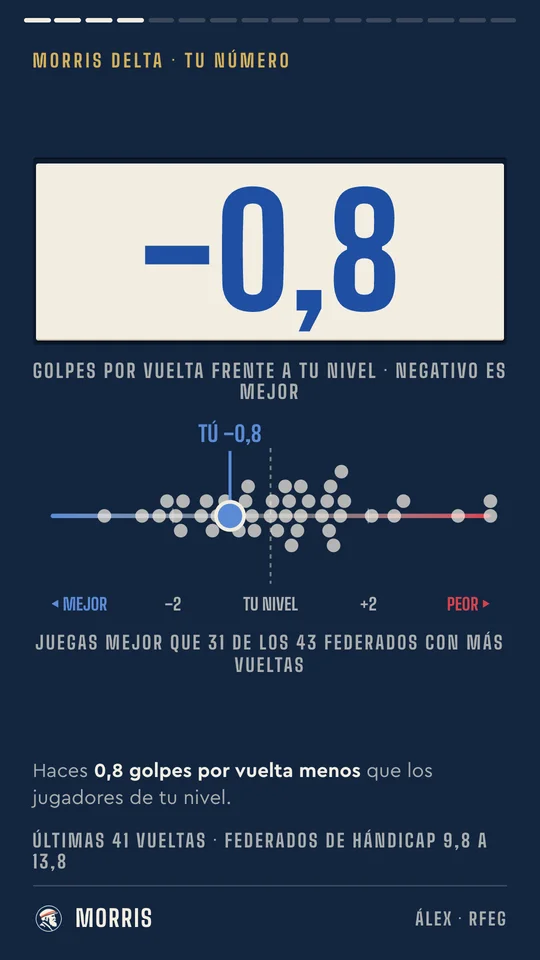
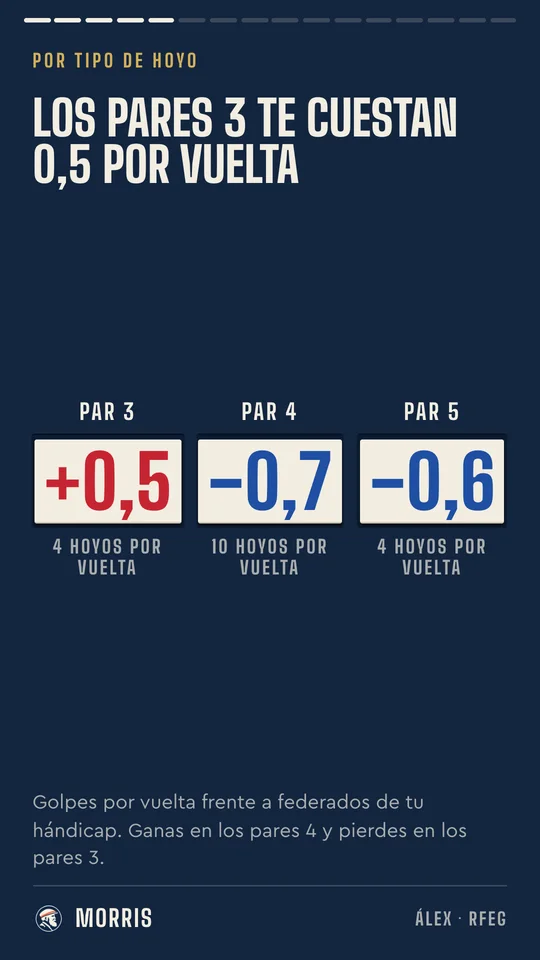
Where it places you
What adds up to the Delta
Every page reads the same way: one number in strokes per round, with its golf sign, and the parts that make it. What shows in red is where you lose strokes to your level.

Ask for your Fairway Report
Your official cards read hole by hole against federated players of your handicap, with each course's difficulty taken out.
Hi Morris, I want my Fairway Report
You will need to connect Federation (RFEG). Morris sends you the secure link for each connection in the chat. This page never asks for a password.
Morris Delta and strokes gained
Measuring against a benchmark is the idea behind strokes gained, which Mark Broadie developed with PGA Tour data: each shot is compared with what a benchmark player averages from the same spot. The Morris Delta applies that logic to the card you hand in.
Two things change. The unit is the hole, not the shot, and the benchmark is federated golfers of your handicap, not tour players. That is why it comes from your official cards with no GPS or sensors, and why it tells you on which holes you gain or lose, not whether the strokes went off the tee or on the green.
How it fits with your handicap and your Morris Index
| Handicap Index (WHS) | Morris Index | Morris Delta | |
|---|---|---|---|
| What it says | Your official level | Your level from all your rounds | How you play for your level |
| Which rounds | The best 8 of your last 20 | Your last 20, from any source | Your RFEG cards of the last 3 years, or your last 40 if that is fewer |
| Against what | The course: Course Rating and Slope | The handicap scale | Golfers of your handicap, hole by hole |
| Who works it out | The RFEG | Morris | Morris, in The Fairway Report |
Swipe to see the whole table.
The three numbers work together. Your handicap is the official one and the RFEG calculates it. The Morris Delta looks at all your rounds in the window, good and bad, against players of your level: that is why it can be negative while your handicap stays put, or the other way round.